The Hidden Accelerator: Building Capacity for the Future of Continuing Education
Michelle Budiwski, MBA (HRmgt), PMP
Post-secondary education has always been a cornerstone of community growth, economic development, and social progress.
Within that system, Continuing Education (CE) has played a vital and evolving role—extending access, responding to community needs, and creating pathways for lifelong learning. Its strength has always been its adaptability: meeting learners where they are, when they need it, and in ways that reflect the realities of work and life.
Today, that adaptability matters more than ever.
But the conversation is shifting—not away from the value of Continuing Education, but toward how we strengthen its capacity to meet growing expectations.
From Capability to Capacity
Through my research for my final project earning me a Master’s Degree in Business Administration specializing in Human Resources and Organizational Learning and Development, I explored a central question:
How do we ensure Continuing Education is equipped—not just expected—to respond to changing learner and workforce demands?
What emerged was a simple but important distinction:
This is not a question of potential.
It is a question of capacity.
Across Canadian post-secondary institutions, CE teams are deeply committed, highly skilled, and incredibly resourceful. But as expectations expand—more programs, faster delivery, stronger partnerships, increased revenue generation—the gap between what is asked and what is supported can widen.
Closing that gap isn’t about pushing harder.
It’s about building smarter.
The Role of Organizational Learning and Development
Capacity is built through people.
And people grow through intentional investment.
My research highlights that strengthening Continuing Education requires a focused commitment to organizational learning and development (OLAD)—not as an add-on, but as a strategic priority.
This includes:
- Upskilling staff in program development, market analysis, sales, and finance management
- Building competencies in stakeholder engagement and partnership development
- Strengthening internal systems for quality assurance and performance alignment
- Supporting teams in adapting to new technologies and evolving learner expectations
When institutions invest in these areas, they are not just improving performance—they are building resilience, agility, and long-term sustainability.
Leadership That Builds Capacity
Capacity building doesn’t happen in isolation.
It is shaped—powerfully—by leadership.
In environments where expectations are high and change is constant, leadership must move beyond oversight and into service.
Servant leadership in Continuing Education means asking:
- Do our teams have the tools they need to succeed?
- Are we creating space for learning, not just delivery?
- Are we supporting growth before we measure outcomes?
Because one of the most important realities in organizational life is this:
If people don’t feel safe to say “I don’t know,” they will struggle in silence.
And when that happens, performance gaps are not visible—they are hidden.
The Power of Trust and Vulnerability
High-performing teams are not built on pressure alone.
They are built on trust.
A culture of trust allows staff to:
- Ask questions without fear
- Identify skill gaps early
- Collaborate across roles and functions
- Engage in continuous learning
In my research, gaps in performance were often linked not to a lack of effort, but to a lack of structured support, clear role definition, and open communication.
When trust is present, those gaps become opportunities—for coaching, development, and innovation.
When it is absent, those same gaps can slow progress and limit potential.
Aligning Skills with Demand
Continuing Education operates at the intersection of institutional strategy and labour market demand.
That position is both a responsibility and an opportunity.
To meet it effectively, there must be alignment between:
- What the market needs
- What programs are offered
- What skills staff possess
This alignment doesn’t happen by chance.
It requires:
- Ongoing market analysis
- Regular program review and adaptation
- Strategic staffing and role clarity
- Continuous professional development
When these elements come together, Continuing Education is able to respond with both speed and quality—delivering relevant, impactful learning experiences while maintaining strong operational performance.
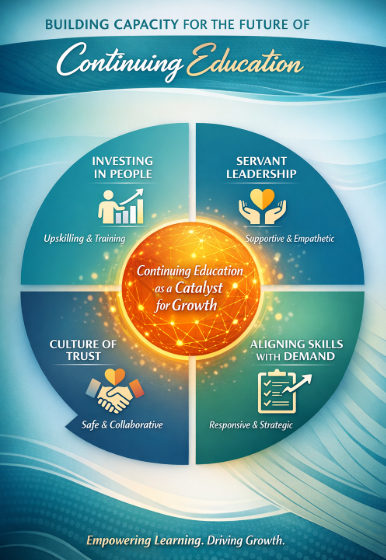
Continuing Education as a Catalyst for Growth
Continuing Education has always been responsive.
What my research reinforces is that, with the right structures in place, it can also be proactive, strategic, and catalytic.
Not by changing its purpose—but by strengthening its capacity.
When CE is supported through:
- Intentional leadership
- Investment in people
- Cultures of trust and collaboration
- Alignment between skills and expectations
…it becomes more than a responsive unit.
It becomes a driver of institutional learning, workforce development, and sustainable growth.
Moving Forward
The future of Continuing Education is not about redefining its value.
That value is already well established.
The opportunity ahead is to build the capacity that allows it to fully deliver on that value—consistently, sustainably, and with impact.
Because when we invest in people, align our systems, and lead with intention…
Continuing Education doesn’t just adapt to change.
It helps institutions lead through it.